

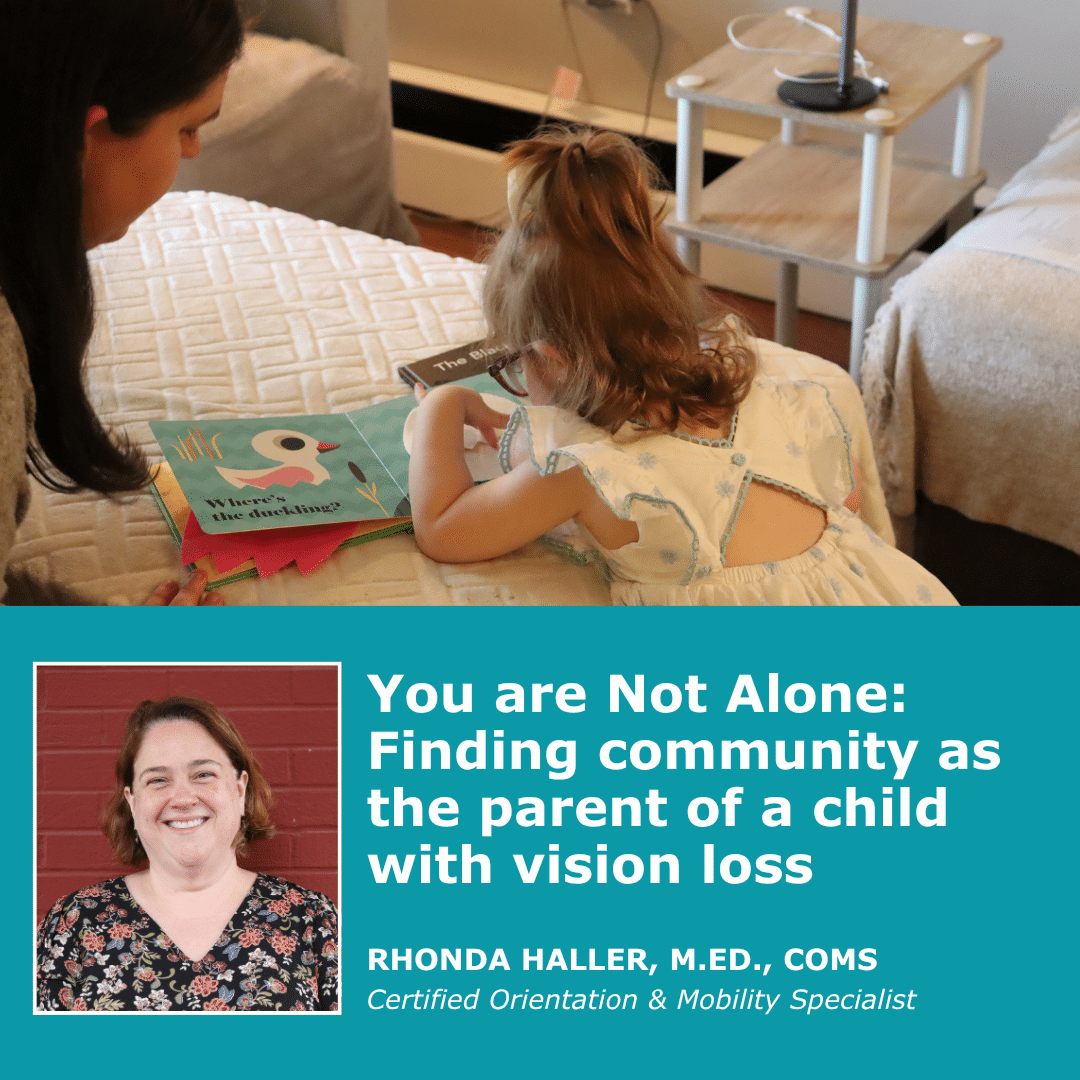
Connecting with Parents Just Like You
Raising a child with differences can feel isolating. You may feel others don’t understand the challenges and joys. You wear a lot of hats and may have struggles other parents may not experience. Connecting with others who have similar experiences can be helpful. Look online or ask about parent groups for the same medical condition or similar vision differences. Connecting with your state services for the blind or early intervention services can help steer you toward helpful resources and groups.
Become an Advocate for Your Child
Do you feel that you are an equal partner in your child’s development and education?
As parents, you know your child best, and you are your child’s first teacher. Your observations and knowledge about your child are so important. Yours is the most significant role and relationship consistent throughout your child’s life. Many other people will be a part of your child’s life within the community and school, including specialized services and experts within the medical and educational fields. It’s important for you to recognize the significant role you play – and to have the confidence to express your opinions and suggestions. You can be a “Voice” to advocate for your child to ensure she/he is receiving the best medical care, specialized educational services, and equity in everyday life. In the U.S. we have a Special Education Law called the Individuals with Disabilities Education Act (IDEA). There are reliable online resources to learn about IDEA and leverage the law for your child’s benefit.
Understand Your Child’s Eye Condition
Childhood visual impairment is known as a “low incidence disability” within the general population. Eye conditions that cause visual impairment are extremely rare and can co-occur with other disabilities. As a result, it is often very difficult for families to find information about their child’s eye condition and how it impacts their visual functioning. Some resources on childhood eye conditions can be found through your child’s ophthalmologist and the American Academy of Pediatric Ophthalmology website.
Visual impairment may be caused by conditions of the eye, but not always. The fastest growing cause of visual impairment is neurological in nature. The eyes may be perfectly formed and function normally, but when the brain cannot process the information received from the eyes, this is called Cerebral/Cortical Visual Impairment (CVI). CVI is often, though not always, associated with other disabilities, prematurity, and oxygen deprivation. CVI Scotland and the CVI Now section of the Perkins School website are excellent sources of information.
Visual impairment, whether ocular (eye-based) or neurological (brain-based), can be congenital (present at birth) or acquired (develop or occur over time). Some impairments are genetic and degenerative, meaning that the child will gradually lose most or all their vision over a period of years.
Research and Access Educational Services
The IDEA requires that vision related services be delivered to students by qualified professionals. Plus, the modifications/accommodations needed by students with vision-impairments to learn and participate actively in school are to be identified and put into place for each child. This is done through the development of your child’s Individualized Education Plan (IEP) by the IEP team of which parents are “equal members”. Your participation with the team is key because you know your child best and understand their unique needs.
Your child should have a Teacher of Students with Visual Impairments (TVI) as part of their education team. A TVI can perform assessments so she can recommend the appropriate accommodations and modifications for your child’s IEP. The TVI may work directly with your child to support their education. TVIs also provide consultation services to the school team so that educators understand your child’s unique needs. Children with low or no vision often need direct instruction to acquire skills and knowledge that children with vision learn by watching and imitating others.
To compensate for decreased opportunities for incidental learning, a TVI can ensure that your child receives specialized instruction in the nine areas of the Expanded Core Curriculum (ECC). The ECC covers assistive technology, career education, compensatory skills (skills necessary for accessing the educational curriculum), independent living skills, orientation & mobility, recreation and leisure activities, self-determination, sensory efficiency, and social skills. If appropriate, a Certified Orientation and Mobility Specialist (COMS) may work with your child to develop skills to enable your child to acquire independence based on their individual abilities. O&M training teaches concepts and skills for safe and efficient navigation and orientation within the environment using various techniques and tools.
About the Author: Rhonda Haller, M.Ed., COMS is a Certified Orientation & Mobility Specialist at Future In Sight. She teaches students in schools how to excel with vision loss and specializes in strategies for how to navigate their physical environment. Learn more about the services Future In Sight provides to youth here.