

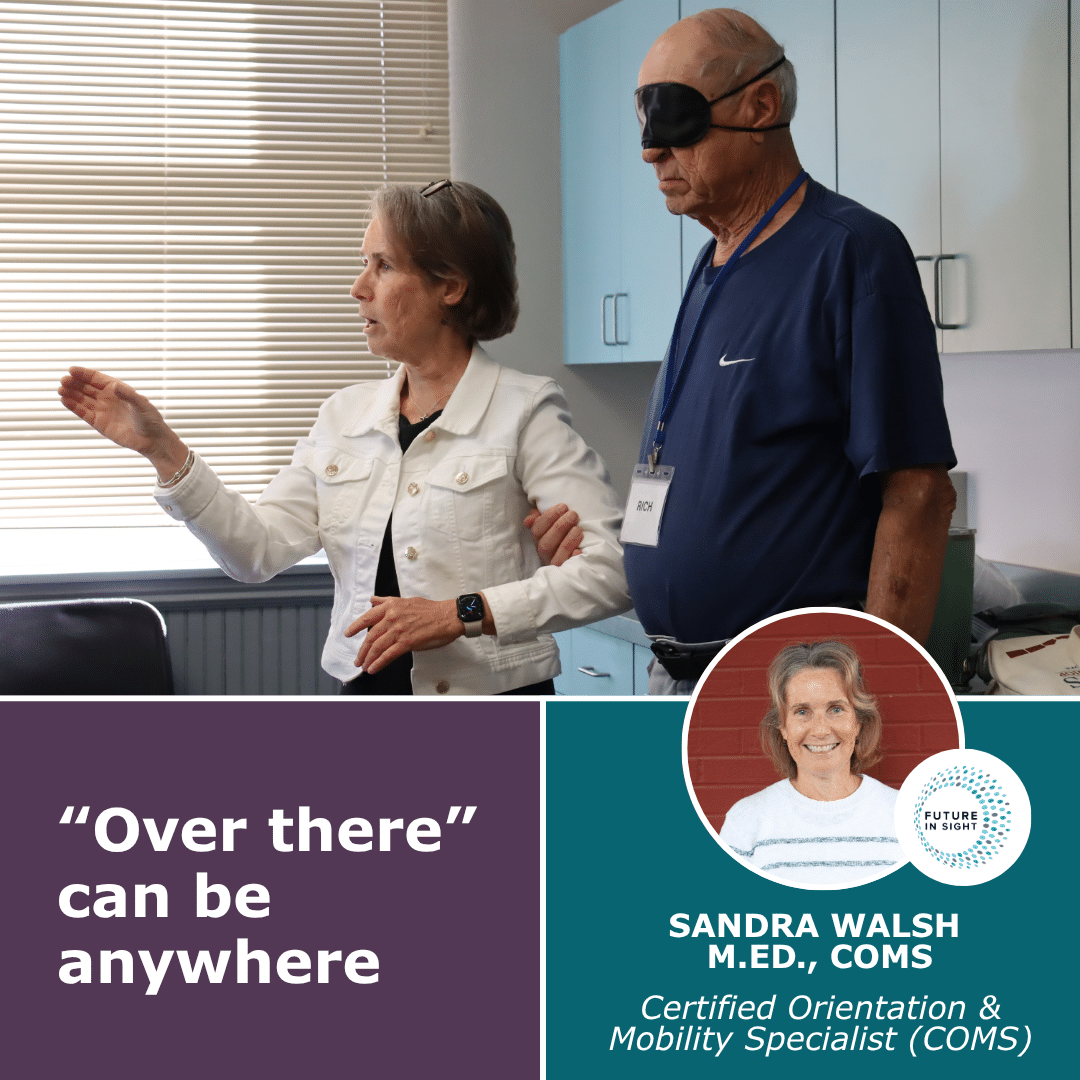
We can all agree that precise, clear directions to locate an item or destination are helpful. Vague directions – like saying “Over there” with a finger point to the general direction – can be anywhere, especially to a person with vision impairment.
When giving directions to an individual with vision loss, use specific directional and spatial words and provide landmarks instead of physical gestures or vague terms.
- Use directional words. Say “on your right,” “turn left,” “straight ahead,” or “behind you” in relation to the orientation of the person receiving the directions.
- Use positional and ordinal words. For example, “on the second shelf” or “in the first drawer.”
- Use clock face directions. The person receiving the directions is in the center of an imaginary clock; 12 o’clock is straight ahead, 3 o’clock is to the right, 9 o’clock is to the left, and 6 o’clock is behind. The other clock face directions are a little subjective but are helpful to narrow down a location. Clock face directions can also be used to describe the location of food on a plate with the dinner plate as the clock.
- Provide reliable landmarks for reference. You could say, “turn left after the elevator to find the exit” or “if you pass the bakery, you have gone too far.” Landmarks are reliable when they are permanent, easy to find using our senses, and unique to the environment. A water fountain in a hallway, although permanent, may not be reliable if there is more than one.
Vision loss is on a spectrum. Functional vision can change in each individual dependent on many factors, like fatigue, illness, or bright sunlight. Some people with vision impairment use a white cane or a guide dog, others do not. When providing directions to another, take a moment to think and put yourself in the shoes of the person receiving the directions. The habit of providing clear, precise directions will help everyone.
About the Author: Sandra Walsh is a Certified Orientation & Mobility Specialist (COMS) for Future In Sight. She visits students with visual impairments in schools to teach them strategies on how to navigate their environment. Click here to learn more about how to interact with individuals who are blind and visually impaired.