

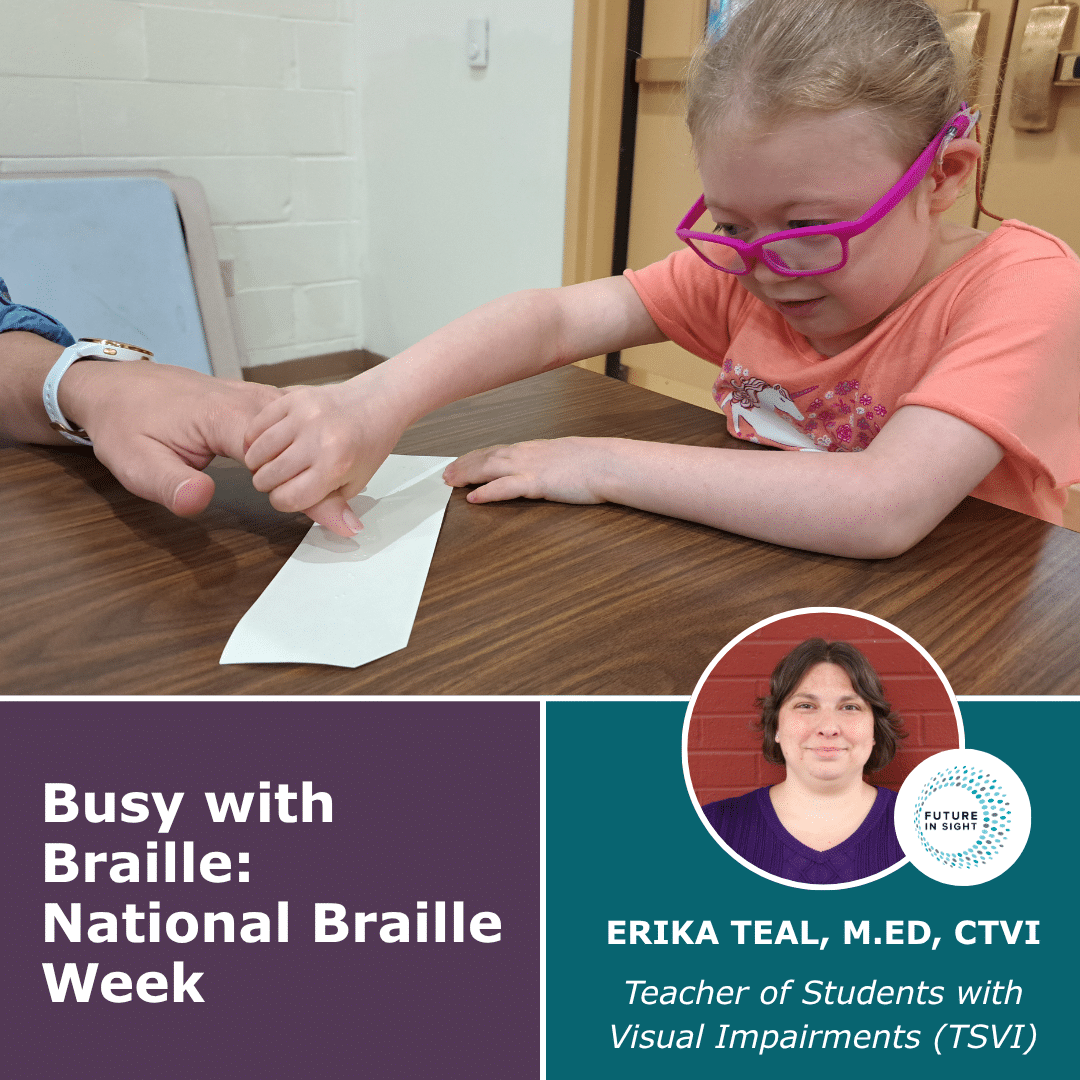
Every year, the blind and low vision community celebrates National Braille Week during the second week of October. While World Braille Day is January 4th – the birthdate of its inventor, Louis Braille – National Braille Week is a whole week to celebrate this unique way of accessing print.
In a world of screen readers, audiobooks, and AI narration, some feel that braille is becoming less relevant. But not every person learns the same way, and it’s essential that people, especially children, with visual impairments have the opportunity to learn braille. The goal of National Braille Week is to highlight this special way of interacting with print and to raise awareness for how individuals who are blind and visually impaired can use it to live independently. Braille can give access to novels, community signs, menus, and more. For some, it can be life-changing.
To honor National Braille Week, here are five fun facts about braille:
- An arrangement of braille dots is called a “cell.” A braille cell is six dots in a two by three grid. Dots in the cell are raised in different patterns to create different symbols.
- Braille is not a language. Braille is a code, meaning each symbol is a substitute for something in a written alphabet. It follows the same language rules, grammar, and sentence structure as the language it is encoding.
- Braille is more than just the alphabet. There are braille symbols that represent punctuation marks, blended sounds, parts of words, and even entire words, all with some combination of six dots in a cell.
- You can type in braille. There are special keyboards that provide six-key entry, meaning there are six buttons that correspond to each of the six dots. The Perkins Brailler is most known for this style of typing, but modern electronic braille displays like the Focus series by Freedom Scientific, the Brailliant line by HumanWare, and the BrailleSense series by HIMS, all feature six-key entry.
- There is braille in many languages. The braille code has been adapted in over 150 languages and formatted to over 130 different alphabets. This includes non-Latin alphabets like Hebrew and Arabic, and symbol-based writing systems like Chinese and Japanese.
Braille has been providing independence to individuals with visual impairments for decades, and will continue to do so for decades to come. This month, take some time to recognize and celebrate braille and all it has provided to the blind and low vision community.
About the Author: Erika Teal is a Teacher of Students with Visual Impairments (TSVI) for Future In Sight. She works with students in schools to teach strategies for navigating life with a visual impairment. Learn more about the services Future In Sight offers to youth here.