

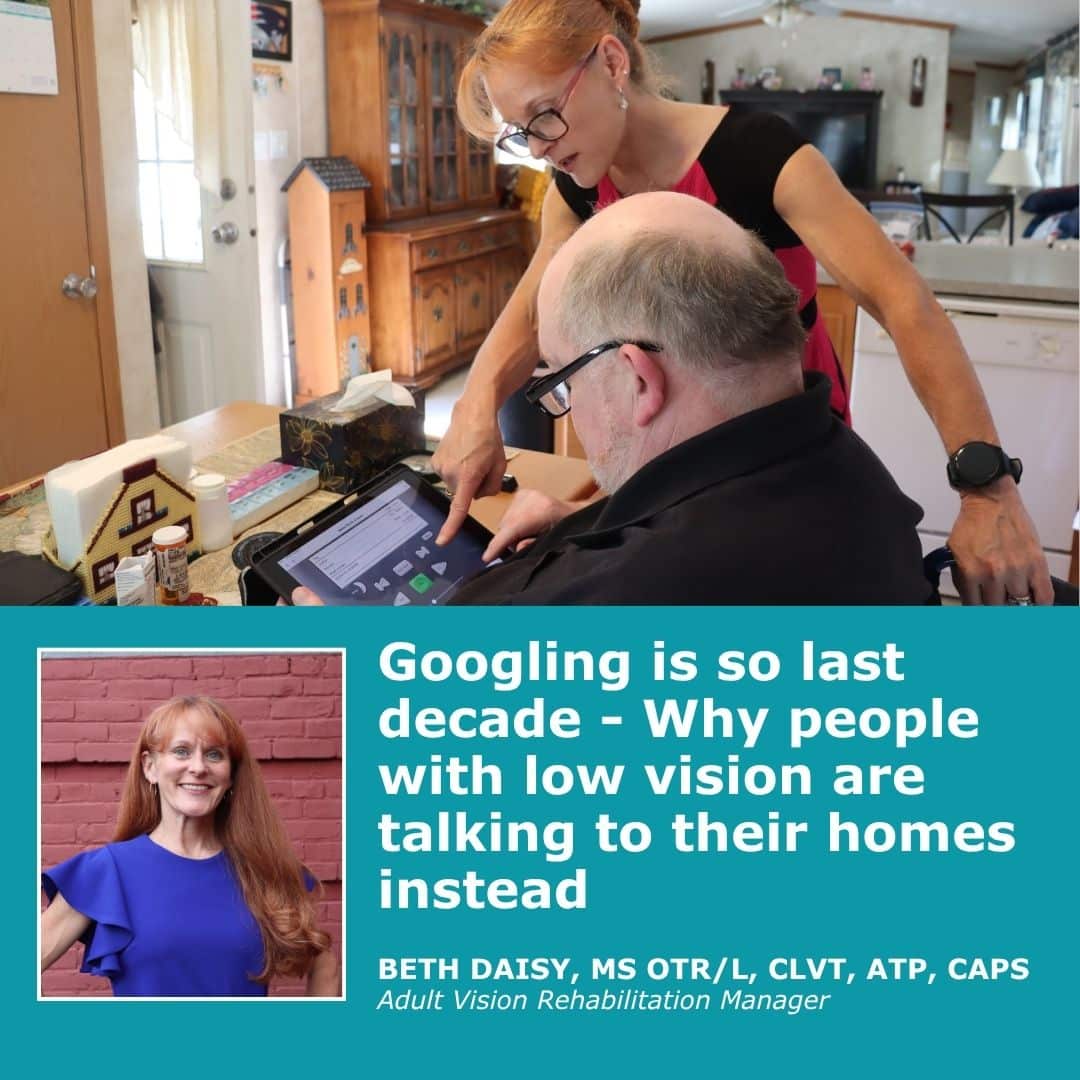
Remember when the answer to every question was, “Just Google it”? Need to know the weather? Google it. Store hours? Google it. What’s the capital of Maine? Google it.
For many people with low vision, “just Google it” isn’t always so simple.
Finding information on a phone or computer can require navigating small text, low contrast, pop-up ads, cluttered websites, and endless scrolling. Even with assistive technology, it can take significant visual effort to find a simple answer. But what if you could skip the screen entirely?
Enter smart home technology.
Whether it’s Alexa, Google Assistant, or Siri, today’s smart speakers and voice assistants can provide information instantly with little to no visual demand. Instead of searching, typing, zooming, pinching, and squinting, you simply ask: “What’s the weather today?” “What time does Walmart close?” “What’s on my calendar?” “Read me today’s news.” And just like that, the answer comes to you.
Your Smart Speaker Is Basically a Low Vision Sidekick
Smart home devices can help with much more than answering random trivia questions. They can:
- Create and manage shopping lists
- Set medication, appointment, and task reminders
- Request an Uber ride
- Call and message friends or family members
- Read audiobooks and podcasts
- Play music
- Announce who’s at the front door when paired with smart cameras
- Control lights, thermostats, and appliances with voice commands
- Find your misplaced phone
- Start timers while cooking
- Provide recipes and step-by-step instructions hands-free
- Answer questions without requiring a screen
For many people with low vision, this means less dependence on visual information and more independence in daily life.
The Best Accessibility Tool Might Be the One That’s Already Listening
Smart speakers have quietly become one of the most powerful accessibility tools available. They’re relatively inexpensive, easy to use, and can reduce visual fatigue throughout the day. Instead of spending energy trying to see information, people can spend that energy doing things they actually enjoy.
And let’s be honest… If given the choice between squinting at a screen for five minutes or casually asking the air a question while making coffee? The air wins… every time!
The Bottom Line
Technology keeps evolving, and accessibility is evolving with it. For individuals with low vision, smart home technology isn’t just convenient. It’s a practical tool that can promote independence, save time, reduce frustration, and make everyday tasks easier.
So the next time someone says, “Just Google it,” you can smile and say, “That is so last decade!”
About the Author: Beth Daisy, MS OTR/L, CLVT, ATP, CAPS is the Adult Vision Rehabilitation Manager and an Occupational Therapist (OT) at Future In Sight. She oversees our Adult Services Team and works with individuals in their homes and communities to help them continue to live as independently as possible. Learn more about our adult services here.